 |
||||||||
 |
||||||||
|
|
|
|
|
|
|
|
|
Press News:
January 2005
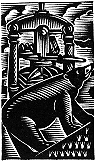
Wood engraving by John DePol
(from Utile Dulci: The First Decade at Barbarian
Press, 1992)
Other pages of Press News can be selected from the menu below.
Press News: January 2005
By way of introduction ...
It is typical of the character of Barbarian Press that the recent celebration of our 25th anniversary took place in our 27th year. Long-time friends and subscribers will nod sagely, recognizing a characteristically rhapsodic carelessness. Similarly, it shouldn’t be surprising that this Press News is being updated a mere twenty-four months after the previous version, dated January, 2003. We offer no excuse, partly because there isn’t one beyond the usual pressures of work; however, we can offer an apologia which will serve nicely as an opening for this edition of Press News.
The internet, that cancerous growth industry of ill-digested information, has developed its own frenzied polity, making it obligatory to update websites continually when one might more reasonably be reading, flying kites, excoriating politicians, or playing with the cat. In fact, it seems to demand that people have a website even if they haven’t the slightest need for one. Thus, teenagers and other children set up personal websites in which we may learn of their fascinations with the latest pimpled pop pundits and share their inmost thoughts on the subject of the relative ‘grossness’ of kissing with, or without, tongue. So much I have learned from scholarly research. I take leave to suggest, in the face of clear popular opinion to the contrary, that the world is no better for such information, although qua information it must be said that it compares favourably with most of what is provided on the net for students in the fields of literature, history, and the arts, where tongues seem more tied than titillating.
Yet there are positive things to say about the internet. The press website has certainly brought us more contacts with people, many of whom have written to us about books or printing, attended our workshops, apprenticed with us, bought our books, and become friends. For that alone it has been more than worthwhile. But the pressure to update information, as if we were being monitored continually by hordes of what Mencken called bibliobibuli desperate for the next fine edition, is wearing. We have discovered a way around that pressure, that guilt, however - a tactic which has proven successful and which will, we hope, become popular generally on the internet: we ignore it. We get to it when we can.
... In fact we are getting to it now, for we have a new book whose information on the site needs cleaning up, one project which we have sadly had to abandon, and some other books which have gone out of print. And one or two things have happened in the last two years, surprisingly. So make sure you are sitting comfortably (not an easy task in front of a computer screen) with a suitable libation in hand, and prepare to indulge in
Press News: January 2005
Where to begin? Well, probably with the four books which have appeared since January 2003, three from Barbarian Press and one from our daughter Apollonia’s Horse Whisper Press. The first of these, Endgrain Editions Three: Peter Lazarov, was published in the summer of 2003, a few months before a second visit from Peter, who was in Vancouver in September of that year as Artist in Residence at Malaspina Printmakers’ Co-operative, a renowned Vancouver studio. Peter spent a happy month there working toward two projects he has now produced from his own Pepel Press (of which more later). The visit concluded with an exhibition which was well-attended and dramatically showed the range of his work. Endgrain Editions Three was prominently displayed.
The reaction to Peter’s book has been gratifying. His work particularly impresses printmakers and engravers, but collectors and aficionados of wood engraving have been passionately engaged by it. On the other hand, its strength, its modernity in the face of the more traditional engraving of the European and British schools, and its references to expressionism and surrealism have alienated some people. That, of course, is a good thing: it would be a tedious world if everyone agreed, and a publisher who is all things to all men should look to his tastes.
On his return to the Netherlands, Peter established his own Pepel Press, from which he has so far issued two publications: Rubbing Roads, a group of prints with poems by various friends of the artist celebrating friendships in English, Dutch, Japanese, and Bulgarian; and Shoji, an accordion book with prints and text. These are both produced in small editions (under 50 copies with both Deluxe and Regular states) on paper made by Peter in Japan at a paper commune where he studied on two different occasions. If you are interested in exploring more of Peter’s work, or looking at these two books, you might look at his website: http://193.173.51.203/Lazarov/html/Home.html.
Our next book, The Eve of St. Agnes, came about as something of a surprise, in the sense that we had no long-range plans to produce it. It is true that as time goes on and we produce more “big” publications like Endgrain Editions Three and Founts & Circumstance, we welcome the chance to publish small books occasionally, and it is also the case that we enjoy publishing poetry. However, The Eve of St. Agnes actually emerged more pragmatically, as a means of acquiring a fairly large amount of Poliphilus type for our upcoming edition of Pericles.
As I related in an earlier edition of Press News, a few years ago we acquired several founts of new mats from the Monotype Corporation and some display mats from other sources, with the intention of establishing some sort of co-operative foundry here in western Canada with other like-minded printers. Unfortunately that never materialized, and the necessity of laying in some new type to replace our rapidly wearing older founts became critical. Acting on wonderful advice, we had contacted Michael Bixler at the typefoundry operated by him and his wife Winifred in Skaneateles, New York, and had agreed to a trade of some mats for new type. Michael, quite understandably, much prefers casting composition (that is, text composed on the Monotype keyboard) to founts of type laid out in rows alphabetically: he accordingly charges much less for composition, and it seemed to us that we could have a substantial poem set by Michael to our specifications, print the book, then distribute the type and re-use it. We decided to choose a poem susceptible of illustration, and to engage an engraver new to us to provide the engravings. The Eve of St. Agnes was the result. It is a lovely, small book with a dramatic full-page frontispiece, two spots, a tailpiece, and a whimsical new press device all engraved by Andy English. Its reception has been enthusiastic.
We subsequently had Michael set the essays for Hoi Barbaroi in Monotype Bembo, and used the distributed type to hand-set the rest of the book, and we will hope to lay in new type in the future by means of the same cunning plan. Next up, we anticipate, will be Shakespeare’s Venus and Adonis set in Blado, the companion italic to Poliphilus, for later use in Pericles.
Hoi Barbaroi
A bibliography at the 25-year mark seemed a sensible idea, both for reasons of celebration and for the practical purposes of having a record of what the press had published so far. Lists are a secret passion of most bibliophiles: I have rarely met a real reader and lover of books who did not enjoy poring over booksellers’ catalogues, or the tables of contents in anthologies. It was W. H. Auden, I believe, who once said that a love of lists is the beginning of the love of poetry, and the structure of lists can contain everything from love poems - which after all are catalogues of the beauties of the beloved - to ... well, bibliography.
Perhaps rather prematurely, we had published a bibliography in 1988, ten years after we started. It was called Utile dulci: The First Decade at Barbarian Press, and in the way of bibliographies it disappeared quickly and is now very difficult to find. We didn’t want to publish a celebratory bibliography at the 25th year which only accounted for the books we had published since that first book, but on the other hand we had no desire to handset and print the bibliographical entries from Utile dulci all over again, so we decided to have the bibliographical entries from that first book printed in offset facsimile on the larger pages of Hoi Barbaroi, with the original page size indicated by rules, and then to continue with the more recent entries in handset type. We also commissioned a photographic essay from our friend David Evans (whose photographs of our books appear throughout this website) and three essays from Robert Bringhurst, Sjaak Hubregtse, and Simon Brett. The brief we gave them was simple enough: we asked them to write something concerning books or printing which was of interest to them and, if it seemed agreeable, to link it to Barbarian Press. What we did not want was a series of encomia. They all obliged with wonderful essays, as did Anthony Rota, who produced a delightful Foreword combining warmheartedness, wit, and affectionate gibes in just the mixture we wanted.
Hoi Barbaroi includes many pages tipped in from earlier books, something we were fortunately able to do because of our seeming inability to throw anything out. There are always extra sheets in the course of printing a book, and we were therefore able to tip in pages which, to those who do not own the books in question, give a vivid sense of their typography and design.
Michael Barnes of Abacus Prepress in Burnaby, B.C., once more gave generously of his time and expertise in scanning and seeing to the printing of the pages from Utile dulci. He also supervised the scanning and printing of David Evans’ photographs in duotone, adding a touch of olive in the overprinting which warms the images perceptibly and gives them a striking depth.
The deluxe copies of Hoi Barbaroi, each of which includes a box portfolio of ephemeral pieces from the press ranging from 1977 to the present, sold out long before publication. The regulars are selling briskly, and we expect the book to be gone before very long.
Apprentices & the Craft
Over the past seven or eight years we have begun to develop as a teaching press, first by giving annual six-day intensive workshops in the summer (which continue), and then by taking on apprentices. The workshops offer a close but necessarily brief look at the fundamental processes involved in publishing letterpress books, but an apprenticeship allows someone interested in this work to begin to grasp the more profound details of a craft which is intricate and demanding.
Those of us who have spent most of our working lives as letterpress printers and publishers in the world of ‘fine press printing’ now find ourselves approaching a certain age. Retirement is not an option for many of us, even if we wanted to retire. But we all realize at some level that we are the repositories of a craft which, for the first time in its 550-year history in the west, has no definably broad base from which to build. Our generation, most of us now well into our fifties, began to acquire presses and type and to learn to print in the late 1960’s and early ’70’s, when letterpress was still relatively common in smaller printing shops, and when nearly all the people printing commercially had a good knowledge of letterpress techniques. All this has virtually disappeared from the commercial scene in the last thirty years, and in consequence it has also vanished from trade schools and commercial apprenticeships. It is no longer reasonable to assume that anyone who wishes to learn how to print from metal type, or even from photopolymer plates, can go to a school to learn it, or can ask advice of the nearest trade printer; or that metal type itself can be found for sale; or that presses for printing handset type or composition will be available and in usable shape, or that rollers for them can easily be renewed once they are worn out. Nor can anyone guarantee that there will be people whose knowledge of such work is based on long experience. Apart from people like ourselves, who do this work as a vocation and for a living, anyone who does know something about it is more likely to have acquired that knowledge in bits by conning books (however carefully) or taking a few workshops on weekends or for a week in the summer. It may be said, in other words, that letterpress printing stands in danger of becoming like the Cornish language, whose last cradle speaker died many years ago, and which is now spoken as a second language by a number of enthusiasts who wish to keep it alive. But of course such a language is not alive - not really - unless a person finds himself speaking it from the heart, perhaps after dropping a hammer on his foot, or while making love. And such knowledge as ours can only be kept alive if it is put to purposeful use.
One of the problems with this discussion is that the central word, “craft”, has been taken over and abused by people who believe that “everyone is an artist”, that “creativity” is a function of being human, and that making Christmas tree ornaments from Styrofoam egg cartons painted with glitter is as “creative” as making a pot on a wheel or a book on a press. It is people such as these who insist on referring to us as “artists”, when in fact we are craftsmen, and proud to be so. A craft is the knowledge of making built into the hands and the sensibilities by continuous application over years, and it aspires not to originality, but to excellence. It cannot be picked up in a week or two of experiment, or studied in a classroom with an occasional practicum to provide ‘hands-on experience’. Perhaps most important, such a knowledge - such a craft in fact, since the craft is the knowledge - can only properly be learned in a practical and applied circumstance. In other words, making a book solely in order to find out how a book is made is less valuable than making a book which is intended to be sold to a public in order to disseminate a text. The first is self-referential, however informative; the second is vital and purposeful. It is in the second process, in an atmosphere of reciprocal celebration between maker and recipient, that a craft will begin to grow.
For this reason, we are increasingly concerned about the increasingly prevalent ‘craft-fair’ approach to learning to print. However well-intentioned the instructor or the student, an atmosphere in which hand composition and letterpress printing are taught as ends in themselves rather than as means to an end undercuts the importance of the craft: the attitude suggests that this is a knowledge kept up historically so that it will not be lost, but not one which has any necessarily practical application. To admit this attitude is only a step away from editing the process so that only the more interesting parts are passed on. If printing is seen as the essence, then hand-setting might be stinted: a small demonstration may be given, and then the students might print their texts from Monotype composition, or even from photopolymer plates. Or if hand-setting were seen as the point of the demonstration (for that is what it will have become in this instance), the type might be distributed later by the person giving the workshop, or simply tossed out and more type cast to refill the cases; after all, everyone knows that dissing type is the most tedious of all tasks.
Well ... I, for one, know no such thing. The contemplative aspects of craft are rarely discussed any more, but the rhythms of work should always include such “down time”. Indeed, one of the virtues of craft work is the necessity for doing menial tasks such as wedging clay for pots, tearing rags for paper, sharpening tools, cleaning a press, or dissing type: these provide times when the craftsman is busy but need not be mentally engaged, when he can be mulling over the work to be done at the wheel, the vat, with the wood or the composing stick, at the layout table, or at the press. They provide the troughs of the waves whose peaks are the actual making, and so offer the possibility of a rising and falling rhythm, a breathing order, to the day’s work.
We now receive a number of applications or enquiries every year from people all over North America who wish to study with us and learn the craft of letterpress printing. Five have come to work with us for periods ranging from daily stints for a month to five months in residence. We have seen all five move forward, each in his or her way, into their own work: Rollin Milroy is now the proprietor of Heavenly Monkey, a successful and inventive press in Vancouver; Nancy Campbell, after returning to England, worked for a time with a press in New York, then at the Alembic Press in Oxford, and has just announced the establishment of her own Burlesque Press; Natasha Herman, who studied printing as an adjunct to binding books (very sensibly feeling that a good binder should understand the allied crafts as well) is now well-established as a binder in Amsterdam; Anik See, who has done two stints with us, has established her Fox Run Press near Madeira Park on the Sechelt Peninsula; and Mollie Zanoni, our most recent apprentice, has also worked with a hand-binder in Washington State for a time, and is now actively seeking out a press and the other necessaries for starting her own press as well.
We are looking forward to welcoming our sixth apprentice, Rachel Pollak, early this year. Life goes on.
Apollonia Elsted and Horse Whisper Press
When our daughter Polly decided in 2002 that she would produce a book in order to pay for a Spring break trip to Europe with her older sister, we were delighted. She decided on a book about horses, chose some poems and passages of literature, and with some help and instruction designed, printed, and bound the book. A Charge of Horse was a success both economically and aesthetically, and the trip to Holland and France was a memorable one.
In 2004 Polly decided to publish another book, this time a gathering of poems by Emily Dickinson called Emily: Opposites Attract. She once again contacted a number of engravers and agreed a price she could afford to pay them for blocks. Not many 16-year-olds have produced books with illustrators like Barry Moser, Simon Brett, Richard Wagener, Andy English, and Peter Lazarov, bound in a marbled paper commissioned from Ann Muir. We are proud of her achievement, and the book shows a considerable advance over her first. We are pleased to direct you to the page on this website which gives you details of the book.
A Silver Anniversary Celebration ...
On November 20, 2004, The Alcuin Society and Simon Fraser University co-hosted a celebration of Barbarian Press which surprised us exceedingly. To be clear, we did know about it in advance: after all, the idea of persuading two such august and dignified persons as ourselves into a strange place only to have several score bibliophiles, librarians, book dealers and the like leap out from dark concealment with loud cries would be grotesque and irreligious. Eric Swanick, the Special Collections librarian at Simon Fraser University, had arranged the whole thing and had even asked us to suggest speakers. We expected a small, pleasant gathering of perhaps twenty or thirty at most, friends we had made over the years among those who had collaborated with us or who collected our work. What surprised us was that nearly a hundred people came.
Many of the people who attended were quite unknown to us, but had bought one or more of our books, or had heard one of us lecture, or had perhaps simply been interested in our ability to survive for twenty-five years doing what we do. A group of typography and design students from Emily Carr School of Art was there, and that was especially pleasing. There were speeches - all admirably turned, gratifying, and enjoyable - by David Bond, Celia Duthie, Scott McIntyre, and Robert Bringhurst: that an economist, a bookseller, a trade publisher, and a poet and typographer could all find pleasure in what we have done seemed to us a fine tribute in itself. And several other people spoke from the floor, among them people who had apprenticed with us, and new friends.
For several days afterward we walked around blushing becomingly. Of course it is always agreeable to have pleasing things said about oneself, but this was more significant than mere compliment could be. Over the last three or four years, when the economy has taken severe blows, when materialism has seemed to have become the new tin god, and when one hears constantly about the necessity of “living in the real world”, our belief in the press and in the efficacy of useful beauty have sometimes come precariously near to toppling. That lovely evening, so kindly given as a gift by so many friends we hardly knew we had, reinforced the conviction that we were doing something worthwhile, and indeed led me to some of the points I have made above about taking care to pass on the craft of letterpress printing and publishing.
When, toward the end of the proceedings, Jan and I were asked to respond, Jan spoke beautifully, with warmth and aplomb. For my part, I found myself hardly able to speak at all for one slightly panicky moment: it seemed impossible to say anything which would adequately compass the kindness we were receiving. So I took refuge in a paraphrase from the redoubtable concert comedienne Anna Russell. Discussing Hamlet in her hilarious send-up of Verdi, Hamletto, or Prosciuttino, she remarks that “if you don’t behave as you’re supposed to, you’re liable to be terribly interesting.”
Very few people would suggest that running a private press was reasonable behaviour. It only remains to hope that the results continue to be interesting.
... and the continuing saga ...
Our plans for books seem to sort themselves into two broad categories: those which are established, planned, and set to go; and those (generally larger) projects which seem sometimes always to retreat into the distance ahead like waves of heat on a summer road. As to the latter, Robert Bringhurst made hay in his speech at the anniversary gathering of the fact that we had told him soon after we met, more than twenty years ago, of our plans to publish Ovid’s Metamorphoses in Arthur Golding’s Elizabethan translation. We meant it then, and we still do: the text is in preparation now, and we imagine we will be able to put the book into the press in or about 2008. The coming year and a half promises examples of both the immediate and the long-range - although we also have sad news of one project, too-long delayed, which we have had to abandon.
The casualty, ironically, is Robert Bringhurst’s New World Suite, which we have been hoping towards for some years. The poem had already been printed commercially in Robert’s selected edition, The Calling, and since for that reason there was no scramble for a first edition we allowed the project to season and simmer. We had planned a CD of a performance of the work, which is written for three voices, to accompany the book, and attempts to find a feasible recording studio had somewhat obscured the book itself. The design had been arrived at, and Crispin was pushing around various ideas involving computer-manipulated types for pages facing the openings of the various sections, to be printed in three colours. Robert, however, found himself in a bind: having been asked for a major work to be printed by the Center for Book Arts in New York to celebrate their 30th anniversary, and not having time to complete the quartet for voices he is working on now, he felt he had to give them New World Suite.
We want to make it clear that this has resulted in no falling out between Robert and ourselves; indeed, later this spring we plan to issue a pamphlet containing the text of the delightfully witty and gratifying speech he made at our anniversary Festspiel. We hope that those people who expressed an interest in the edition of New World Suite we were planning will contact the Center to ask about theirs. Information about their edition, which will appear later this year, can be found at their website at http://www.centerforbookarts.org/newsite/bookstore/newworldsuite.asp
As for the books which will appear from our press in the next year or eighteen months, some details will be found in the Books Forthcoming section of the website. We are looking forward particularly to publishing two of Shakespeare’s works this year: Venus and Adonis and The Play of Pericles, Prince of Tyre. To have waited so long to publish a complete work by Shakespeare, when he of all writers is the one we most revel in, seems strange even to us. When we first began to print, more than twenty-five years ago, we assumed in our naivety that as a matter of course we would publish all the plays. That will never happen; but we do intend to publish our favourites, and Pericles is one. Furthermore, plans for Twelfth Night are already under way.
These installments of Press News seem always to be born under the shadow of catastrophe: the terrorist attack on the twin towers in 2001, the probable invasion of Iraq in 2003, and now, in January of 2005, the after-effects of the disastrous tsunamis which have killed more than 150,000 people in South-east Asia. That this most recent tragedy is a result of the forces of nature, rather than the stupidity and wickedness of humankind, is hollow comfort. To go on making books in the face of such a world may seem to some a ludicrous and infantile proceeding. But we must all do what we can to make of the turns of minutes, hours, days, weeks, and years some palpable hope and joy. We are not philosophers, doctors, priests, or magicians. We are printers, and this is what we do.
This will be the third time we have turned to Marianne Moore to provide a place to stop. Wherever we are, we look for comfort, and for peace. Something of that human need, now so desperately felt by so very many in Asia and Iraq and Africa, but also in the towns and cities we live in ourselves, is caught in this last stanza from her poem, “The Steeple-Jack”:
It could not be dangerous to be living
in a town like this, of simple people,
who have a steeple-jack placing danger signs by the church
while he is gilding the solid-
pointed star, which on a steeple
stands for hope.
We wish you every good thing for 2005. Thank you for your friendship and your support.
Pax et bonum,
Crispin, Jan, and Apollonia Elsted