 |
||||||||
 |
||||||||
|
|
|
|
|
|
|
|
|
Press
Update:
September 2024
Wood engraving by John DePol
(from Utile Dulci: The First Decade at Barbarian
Press, 1992)
Other pages of Press News can be selected from the menu below.
Press News November 2025
In Memoriam
Jean-françois Vilain
Subscribers are the lifeblood of any private press. We have been blessed over the decades with many loyal supporters. Inevitably, over the long history of the press, some have had to give up their subscription for various reasons; in more recent years, a number have died. Sadly, one of the most enthusiastic and generous advocates for fine press books and a beloved friend, Jean-françois Vilain, passed away on 3 November. Although Jan and Apollonia had the pleasure of meeting him in person when they stayed in his Greenwich Village apartment almost twenty years ago, our friendship mostly developed through email correspondence. A note from J.F.(usually beginning with the greeting, Kaloi K’Agathoi Barbaroi) was always an occasion, marked by gentle teasing (‘not another book of poetry’!), wit, warm appreciation of our work, personal interest, and love. He was a true gentleman with an expansive heart, mind, and spirit. We will miss him deeply. For his dear Roger the loss is unimaginable, and we wish him all comfort and peace.
Rest in peace, Jean-françois – Kalos kagathos

Fine Press Bibliography 2011-2025 –
an Important New Online Source
Many collectors and librarians will remember Private Press Books, an annual ‘voluntary’ survey of presses and their publications published in journal form by the Private Libraries Association, which began to appear in 1959. However, by 2010 the cost of printing production for the PLA, and the difficulty in finding regional editors for Britain, Canada, and the United States willing to take the time and effort to contact and solicit information from myriad presses (herding cats hardly begins to describe the difficulties) meant that the project had to close, and in 2010 the last print issue appeared. It had provided an invaluable overview of the movement for over fifty years: any history of the fine press revival of the latter 20th and early 21st centuries would be all but impossible without it. In the intervening fifteen years there have been various discussions about somehow carrying the project on, with the generally held conviction that any such undertaking would have to be online.
Enter Howard Kistler, who has made an excellent start on an online continuation of this informative source, still sponsored by the Private Libraries Association, and already running to well over 200 pages. The leading page sets out its intentions:
Following in the tradition of the annual bibliographies assembled by Paul W. Nash, this new project seeks to fill the gap from 2011 to the present. It is being undertaken by Howard Kistler and collectors from the LibraryThing Fine Press forum. They are drawing on existing bibliographies of presses plus internet research, as well as referring to their own collections, in order to assemble this list. This is a living document which should grow with time. We welcome input, feedback, and corrections, as well as suggestions for further private presses to include in this bibliography.
Howard has also contacted a number of presses directly, and will, we gather, continue to do so. But the input from collectors is a new and very fruitful way of finding out just what is going on, since collectors often have the infectious enthusiasm that such a project must have. Anyone who collects fine press books seriously should take the time to explore this website, and if any useful information comes to mind, please submit it.
The link to the Bibliography is www.plabooks.org/bibliography. Please support this enterprise.
And the Barbarian story continues . . .
The last few months since our press news update in February have been busy and fruitful at Barbarian Press. We have completed our newest book, Weathers: Selected Poems by Thomas Hardy, along with two more pamphlets in the Loose Canons series; we have made decided progress on Bordering on the Sublime and begun work on a book featuring the poetry of Heather Simeney MacLeod.
Weathers: Selected Poems by Thomas Hardy
The Hardy project was a profound pleasure in every respect, beginning with the poems themselves. Better known now as a major novelist of the late 19th and early 20th centuries, his poetry has tended to be neglected by comparison. There is no better way to become intimately acquainted with a text than to set the words letter by letter in a composing stick, and then print them with intense attention to the clarity of the letters and overall consistency of colour page after page. Such attention not only produces a fine image on the page, it draws the compositor and printer into a unique relationship of sympathy and understanding with the meanings and implications of the poems themselves. Presenting the work in this way coaxes the reader equally to take the time necessary to come to a deep understanding of the meaning and implications embedded in the words. This is the nature and purpose of the finely printed book.
Hardy’s poetry more than rewards the makers’ and the readers’ efforts. It covers a range from the satirical to the sincere, from the comic to the tragic, in a language perfectly suited to the subject of the poem, whether in dialect or finely honed lyricism. In many poems, he paints vivid, sympathetic portraits of country characters clearly drawn from life, laments the passing of a simpler way of living, and celebrates the spirit of endurance and survival that remains. In others, he presents and reflects upon the human condition as a whole within the context of an achingly beautiful natural world. He has an eye for detail that seems unerringly true.
The wood engravings by Jane Randfield provide a perfect visual accompaniment to the music of the poems. They take the viewer more deeply inside the world of the poems with images of extraordinary dynamism and perspective. Leaves scuttle along the ground, cuffed by the wind; clouds swirl and move across the sky. Somehow, in the very strokes cut into the wood, she forces the eye to follow the movement in the landscape. One extraordinary example of this is her engraving which introduces the poem, ‘Domicilium’. The poem describes Hardy’s memories of the place in which he was born, and the stories his grandmother told him of years gone by; the engraving shows the grandmother sitting with her grandson as they look out over the cottage and surrounding landscape. They sit in the far left hand corner of the image, and the grandmother’s hand is outstretched toward the scene before them, leading the little boy’s eye outward to the garden and cottage, and then to a distant lone tree, and beyond to windblown clouds. The engraving captures the sweet relationship between the two figures, the drift of memories between them, and the landscape both immediate and unchanging. The reader/viewer takes their journey, guided by the image into the narrative of the poem.
We are reminded again with Jane Randfield’s engravings of the empathy that can exist between artist and writer: Simon Brett’s kinship with Shakespeare in our edition of Pericles and Andy English’s identification with the poetry of Molly Holden in Sudden Immobility spring foremost to mind. We stand back in awe and rejoice, and then do our best to do justice to the vision expressed in their engravings. It is a kind of mystery when writer, artist, and maker come into harmony with one another: it cannot be contrived or even sought, but comes unbidden – always hoped for, and ever welcome.
Jane was endlessly enthusiastic and accommodating, even recutting a block that would not work in the space allowed, and sending along a couple of small spot engravings that appeared unexpectedly out of some extra bits of wood. To work with such a generous and consummate artist is one of the greatest privileges of what we do. In a world too often consumed by sound and fury, we have the blessing of quiet, fulfilling work in the company of other like-minded souls. Utile dulci
Loose Canons
Loose Canons Three: Edward Thomas and Loose Canons Four: Merrill Moore feature two different but equally accomplished poets. Thomas, an Englishman, wrote poetry in a short burst of intense creativity in the three years before he was killed in the First World War; Merrill Moore, an American, wrote thousands of sonnets over the course of his long career as a doctor and psychiatrist. Each deserves to be read with close attention and reflection to appreciate the insights and lyricism of each. This series of pamphlets, with the texts chosen and designed by Crispin, continues to be set and printed by our capable part-time Barbarian assistant, Lea Sánchez Milde. Lea has shown an instinct for craftsmanship from the beginning, and an ongoing determination to refine her eye and skills as a printer. As the older Barbarian eyes begin to have greater difficulty in detecting a hair or a nick on a piece of type, the keenness of vision of both Lea and Apollonia help sustain the level of excellence to which we all aspire.
Heather Simeney Macleod. Let the Bees Go Then. Poems Selected and New.
A new book is on the horizon for early 2026. It has long been on our minds that we would like to celebrate the poetry of Canadian poet Heather Simeney Macleod. Crispin first came across her writing some twenty years ago when asked to consider the work of a number of young contemporary poets. Heather immediately stood out from the rest.
We both felt that frisson one feels when encountering a voice which speaks truth in a language that is beautiful and inevitable. There is both revelation and recognition in such writing: the previously unknown and intimately known cohere. Her poetry joins the everyday with the extraordinary; memory with loss; European culture with indigenous story and experience; sorrow with joy. Above all, Heather Simeney MacLeod writes with an emotional honesty and depth that speaks for the human heart through all cultures, generations, and experiences.
This selection of her poems, chosen by Crispin and Jan, takes its title from an unpublished poem, ‘Let the Bees Go Then’, and is drawn from her four previously published volumes of poetry and more recent work. Apollonia is well into the setting of the text and has begun printing it on her Heidelberg windmill press; Lea will join her in the setting and printing of this book when she has finished distributing the type and sewing the remaining pamphlets for Loose Canons Four.
Bordering on the Sublime Progress Report
We are currently in the process of setting and printing the final chapter of the main body of text. We had hoped to have this finished by the end of the year, but it turns out that we have been overly optimistic as usual. (This will come as no surprise to long-standing subscribers.) Crispin found, during the course of researching and writing this major section on Bert Smith, Curwen designer and compositor of ornamented borders and fleurons, that there was disturbingly little known about him and much to find out. With diligent exploration and with the abundant help of two informed colleagues, he has been able to paint a revealing portrait of the man and his place in creating the ornamental typography for which the Curwen Press was renowned. This last 'chapter' has grown from a projected 24 pages to more than 60 with numerous ornamental specimens composed by Crispin using the models created by Bert Smith.
Once this chapter is completed — potentially early in the new year — we will turn our attention to the appendices, including a catalogue of ornaments used throughout the book, a detailed bibliography, and an index. As the book has grown from a rough estimate of 200 pages to nearer 300, Crispin realized that an index would be essential to facilitate easy referencing of specific subject matter. With his passion for bibliographic matter, he is approaching this new task with much enthusiasm, but without an accurate sense of the time involved as yet. However, we estimate now that with reasonable luck and a fair wind, Bordering on the Sublime will go to the binder in the summer of 2026.
As always, we are immensely grateful for the loyalty, support, and abiding patience of our subscribers to this book as we navigate this long journey toward completion of this project. It was begun 16 years ago with subscriber contributions toward the purchase of the Curwen Press ornamented standing borders, and continued since with on-going infusions of funds and sustaining moral support from customers old and new. We certainly do not view Bordering on the Sublime as our swansong, or even our last major book, but it is certainly a work of substance and a milestone for Barbarian Press. It is in every sense the result of a collaboration among many hands in the doing of the work and in the support of that work by generous patrons.
Family News
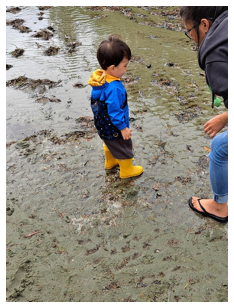
For the first time since grandson Michael’s arrival in November 2023, we headed off for a family holiday in early September. We wanted to mark two occasions: one our 53rd wedding anniversary on September 6, and the second, Jan’s 75th birthday in October. We felt a hankering to spend some time by the ocean again after many years living in a rural wooded area hemmed in by hills and trees – the real ocean – the west coast of Vancouver Island, where you can stand on a beach that spreads for miles and look out at a sea that extends as far as Asia. We rented a small cottage for the five of us just outside Tofino that sits on the edge of a small cove. Michael was introduced to the joys of digging in wet sand, and we all took walks along the beach. The ultimate strand is ‘Long Beach’, an endless stretch of sand. Jan and Crispin each stood and communed with the sea and the sky. Refreshed and uplifted, we returned home, ready for work, yet determined to come back next year. The pictures below tell some of the story.


Vanishing Crafts
A discomfiting note. Heritage Crafts is a British UNESCO sponsored and associated charity which advocates to the British government and internationally in support of crafts considered to be in the category of Intangible Cultural Heritage. The organization publishes and keeps updated a ‘Red List’ of crafts considered to be endangered [‘serious concern about ongoing viability’], critically endangered [‘with a serious risk of no longer being practised’], or extinct [‘no longer practised’] in Britain.
In the current Red List, note the following, all with reference to fine press printing and bookwork:
Endangered – Letterpress printing, Type Founding and manufacture, Stone Lithography, and Paper Marbling;
Critically Endangered – Commercial Handmade Papermaking & Vellum and Parchment making;
Extinct – Mould & Deckle making (for the production of handmade paper) and Gold Beating (the creation of gold leaf used in fine leather bindings).
For more information on these and other crafts (some of them astonishingly interesting) see the Heritage Craft site here: www.heritagecrafts.org.uk
Note that these notifications are peculiar to Britain, and that there may be more hope in other countries. Nevertheless, none of these skills is likely to guarantee a comfortable living without much hard work, or indeed at all; however, they may very well provide the satisfaction and pleasure found in good work for those suitably minded. But to anyone who cares about fine artisanship in any area these are serious warnings. In mitigation, it should be said that there are many fine press printers active (q.v.), and that papermaking and type founding are both being pursued as I write by enthusiasts who have acquired disused equipment and learned the skills involved.
I have no wish to cast a pall, but these cautions are relevant in contrast to the optimism, the delighted discovery, and the relative availability of materials, encouragement, and advice that were present at the beginning of the private press revival of the mid-20th century – a brief outline of which I have set out below.
The Private Press Revival
The ‘new’ letterpress and private press movement that took fire in the 1960s marked a revival of interest in the skills of hand-work in book printing and publishing, and an endeavour to preserve the traditions of a craft that stretched back more than 500 years in the western world. Skills like type-casting, hand composition, letterpress printing, and all the associated crafts of hand papermaking, book binding, blockmaking, wood engraving and other methods of illustration for books were all newly celebrated and revived in the 1960s by a post-war generation who learned what they could from practitioners nearing, or past, retirement, or found whatever instruction was available in books or from the study of examples. They rescued presses ranging from 19th century iron handpresses like Albions, Washingtons, Columbians, and Stanhopes to vertical platen presses, cylinder proof presses, and high speed production presses like Heidelbergs and Wharfedales, all of which might otherwise have been broken up for scrap. They salvaged type, casting equipment, and other machinery and materials in danger of being discarded as ‘no longer practical’, often able to buy them for a song, and sought out and procured tools and equipment for hand composition, binding, papermaking and other crafts from artisans who had retained them without imagining they would ever be used again, and who were more than happy to provide them, knowing that the crafts would be carried on.
Of course letterpress printing, hand-setting and the like never completely disappeared, but these techniques gradually vanished from commercial printing, being replaced by photo typesetting, offset lithography, and other developments, and eventually by digital printing. The postwar letterpress revival – what has come to be called the ‘fine press’ movement – was most notable for re-establishing letterpress and handwork as a functioning element in the printing of books, generally published as limited editions.
To speak only of such presses publishing in English in Britain, Canada, Australia, New Zealand, and the United States – and only because I have less knowledge of others – hundreds, if not thousands of artisan presses of all shapes and sizes, ranging from large operations publishing major books to tiny presses producing pamphlets, chapbooks, and broadsides, have at various times been active in this printing revival for more than 60 years now. Interested book dealers have developed expertise about the books made by these presses, have provided a market for their sale, and in many cases have published catalogues which have preserved excellent bibliographical information. It has been a heady time, and it continues to be so. A community of artisans and artists has coalesced around the production of books of staggering variety, proving to be a vital, exciting, and hugely productive movement in many countries around the world.
The story of this private press revival, the new artisan presses of the late 20th and early 21st centuries, has yet to be written, although its time is overdue. However, it has been well but sporadically documented not only by the thousands of books these presses have produced, but in several journals devoted to what is now more usually called the ‘fine press book’, among them Fine Print [1975-90], Amphora [1967- and continuing; the journal of the Alcuin Society of Canada], Northwest Book Arts Review [1981-82], Bookways [1991-95], The Devil’s Artisan (later DA) [1980-2023], and now Parentheses, the journal of the Fine Press Book Association which was established in 1997 and continues to publish today. Fine Print, the first of these devoted entirely to artisan printing, and its editor, the late Sandra Kirschenbaum, quickly made an immensely significant contribution in drawing these presses together into an international community, making them aware of one another and allowing them access to one another’s work with all the exchanges of ideas and technical support such communities facilitate. (Parenthesis 9 includes Linnea Gentry’s obituary of Sandra Kirschenbaum with a brief account of her life.) In addition to these, many other journals, newsletters, and magazines have come and gone.
Standing above all of them has been Matrix, comprising thirty-six substantial volumes published almost annually from 1981 to 2020 by John and Rosalind Randle at Whittington Press, a magisterial journal which deals not only with contemporary presses in Britain, North America, and Europe, but reaches back into the historical private press movement that began with William Morris’s Kelmscott Press in 1889 and was the antecedent to a movement which carried through the 20th century, lost momentum during and after the Second World War, and then revived in the 1950s and ’60s, as we have said, to continue today.
Blessings to you all, from all of us,
Crispin, Jan, Apollonia, and Lea November 2025